 Ultimate guide
Renovation Project Management for Businesses: 2026 Guide
Table of Contents
- The Business Case for Professional Renovation Project Management
- How to Manage Renovation Project Subcontractors Without Chaos
- Commercial Renovation Permit Requirements: What Businesses Must Know
- Commercial Renovation Timeline Estimation That Holds Up
- Budget Control, Cost Estimation, and Change Order Management
- Safety, Risk Mitigation, and Regulatory Compliance on Active Job Sites
- Technology and Tools: Cloud-Based Software, Remote Monitoring, and Workflow Automation
- Conclusion: Building a Repeatable Renovation Management Process
- Frequently Asked Questions
Last Updated: September 12, 2026
The Business Case for Professional Renovation Project Management
Renovation project management is the discipline of planning, coordinating, and controlling a construction or remodeling project from initial scope through final closeout, using a defined budget, schedule, and accountability structure. For businesses, that discipline is what separates a controlled build from a slow financial bleed. A renovation that runs long doesn't just cost more in labor and materials; it disrupts revenue, displaces staff, and delays the day the space starts earning again. At Allied Construction Corp, we've managed kitchen, bathroom, basement, and commercial renovations across Nassau and Suffolk counties and all five boroughs. The pattern is consistent: projects often fail on coordination, not craftsmanship. Below, we'll break down the systems that keep a renovation on time, on budget, and free of the change-order surprises that wreck so many commercial builds.
How to Manage Renovation Project Subcontractors Without Chaos
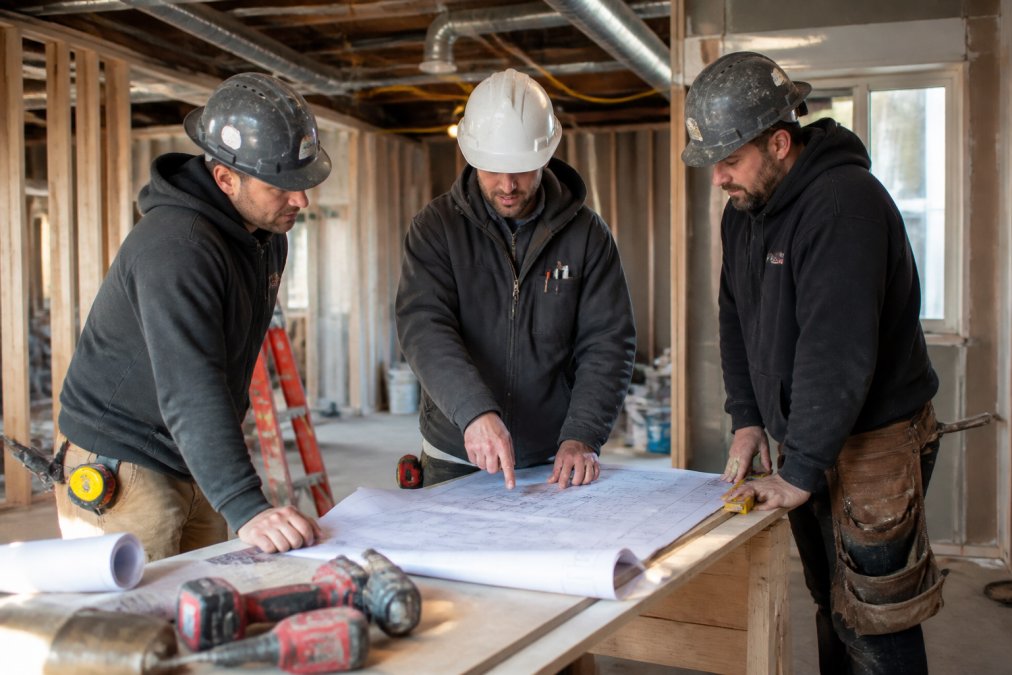
Managing subcontractors comes down to three controls: vet them before they mobilize, define their scope in writing, and hold them to a schedule they helped build. Chaos usually starts at onboarding, not mid-project.
Vetting and Onboarding Subcontractors
A common mistake is hiring on price alone. Verify licensing, insurance certificates, and references from comparable commercial work before anyone sets foot on site. Confirm each trade understands the project lifecycle and where their scope ends, because overlapping trades are where finger-pointing begins. A written scope of work, a signed schedule acknowledgment, and a single point of contact for each sub prevent most disputes before they start.
Communication and Accountability Systems
Daily site logs, weekly coordination meetings, and a shared issue tracker keep every trade aligned. Accountability means tying payment to verified milestones, not calendar dates. When a sub knows the next draw depends on a passed inspection, priorities sort themselves out. This is where contractor coordination either holds together or falls apart.
Commercial Renovation Permit Requirements: What Businesses Must Know
Commercial renovation permit requirements vary by jurisdiction, but nearly every project needs a building permit, trade permits for electrical, plumbing, and mechanical work, and a certificate of occupancy update before reopening. Skipping permits doesn't save time; it stalls the project at inspection and can force demolition of finished work.
Local Permits and Inspections
Most municipalities require plan review, staged inspections at framing, rough-in, and final, plus a sign-off before occupancy. Confirm who pulls the permits before work begins. When a general contractor handles permit acquisition and inspection scheduling, the owner isn't stuck managing paperwork while crews wait. Local building departments publish their own submission requirements, so verify the current checklist directly with the authority having jurisdiction.
Specialty and Environmental Permits
Restaurants, medical offices, and labs often trigger health department, fire suppression, and environmental reviews. Regulatory compliance here is not optional and not fast. Build these approvals into the schedule as hard gates, because a missing specialty permit can idle an entire crew for weeks.
Commercial Renovation Timeline Estimation That Holds Up
Reliable timeline estimation starts from the critical path, not from a hopeful guess. Map every task, identify which ones cannot slip without delaying the whole project, and build contingency around those specifically.
Estimation breaks down when teams ignore permit lead times, material delivery windows, and inspection queues. A practical rule: estimate each phase, then add buffer to the critical path only. Use a phase-based framework so progress is measurable:
| Phase | Key Activities | Typical Duration Driver |
|---|---|---|
| Pre-construction | Design, permits, procurement | Permit review time |
| Demolition | Teardown, disposal, site prep | Scope and access |
| Rough-in | Framing, electrical, plumbing, HVAC | Inspection scheduling |
| Finishes | Drywall, flooring, fixtures, paint | Material lead times |
| Closeout | Punch list, final inspection, handover | Sign-off speed |
Budget Control, Cost Estimation, and Change Order Management
Budget control means controlling change, because the original estimate is rarely the problem. Change orders are. Every scope change should be documented, priced, and approved in writing before the work happens. Verbal "while you're in there" requests are how projects quietly blow past budget.
Building a Cost Estimate That Survives Construction
A defensible commercial renovation estimate is built from four cost layers, not one number:
| Cost Layer | What It Covers | How It Is Held |
|---|---|---|
| Hard costs | Labor, materials, equipment, subcontracts | Committed against signed contracts |
| Soft costs | Design, engineering, permits, inspections, legal | Tracked as fixed or hourly line items |
| Owner's contingency | Unknown conditions, scope creep, minor changes | Held by the owner, released only by written approval |
| Escalation and market allowance | Material price movement between bid and buy | Applied to long-lead items at procurement |
Most practitioners find that a renovation contingency of roughly 10 to 15 percent of hard costs is a reasonable starting range for occupied commercial space, with higher allowances for older buildings where concealed conditions are likely (constructiondive.com). The exact figure should be set by the owner, not the contractor, so the person paying for surprises also controls the reserve.
The Change Order Workflow
A change order is not a conversation. It is a document with a number. Run every change through the same five steps:
- Identify the change in writing, a field condition, an owner request, or a design revision.
- Price it with labor, material, and schedule impact broken out separately.
- Approve it in writing before any work proceeds. No signature, no work.
- Log it against the original budget line so cumulative variance is visible.
- Reconcile it at each pay application so the draw reflects approved changes only.
Track committed costs, signed subcontracts and purchase orders, against the budget weekly, not monthly. When you catch a variance early, you can adjust scope elsewhere; when you catch it at closeout, you just pay. Resource allocation and procurement decisions made in pre-construction determine whether the budget survives the build.
Supply Chain Resilience: The Budget Risk Most Guides Ignore
Material lead times are a budget line, not a scheduling footnote. A single delayed shipment can idle a crew, trigger a change order for remobilization, and push the project past a lease or revenue milestone. Build procurement risk management into the budget from day one:
- Qualify two sources for every long-lead item, switchgear, custom millwork, specialty glass, HVAC equipment, before the bid is finalized.
- Confirm lead times in writing from the manufacturer, not from a distributor's estimate.
- Buy long-lead items before demolition, and store them off-site if the site cannot secure them.
- Price an escalation clause into fixed-price subcontracts so material spikes are shared, not silently absorbed.
- Sequence around the constraint. If a lead time cannot be shortened, reorder the phase plan so other trades work while the item is in transit.
Safety, Risk Mitigation, and Regulatory Compliance on Active Job Sites
Site safety protects people first and the schedule second. On an active commercial site, a single incident can shut the job down and trigger regulatory scrutiny that stalls everything. Risk mitigation starts with a site-specific safety plan, daily toolbox talks, and documented hazard assessments.
Regulatory compliance covers more than permits. It includes worker safety standards enforced by the Occupational Safety and Health Administration, hazardous material handling, and proper disposal of construction waste. Quality assurance and site inspection belong in the same conversation: a defect caught at rough-in costs a fraction of one discovered after finishes are installed. Document everything, because technical documentation is your defense if a dispute or claim arises.
Technology and Tools: Cloud-Based Software, Remote Monitoring, and Workflow Automation
Technology helps most when it improves project transparency, not when it adds another dashboard nobody checks. Cloud-based software gives owners and managers real-time tracking of schedule, budget, and site photos from anywhere.
What to Look For in Construction Project Management Software
Software providers dominate the search results for this topic, so it is worth separating the features that actually change outcomes from the ones that just look good in a demo. The capabilities that matter on a commercial renovation are:
- Budget and committed-cost tracking tied to the same cost codes used in the estimate, so variance is visible without a spreadsheet reconciliation.
- Schedule with dependencies, not just a task list, the critical path has to update when a task slips.
- RFI and submittal routing with timestamps, so response delays are measurable and attributable.
- Change order workflow with approval gates that match the contract.
- Daily logs and photo documentation captured on mobile, geotagged and time-stamped.
- Permission tiers so the owner sees budget and schedule while subcontractors see only their scope.
A common pattern is that teams adopt software for the dashboard and abandon it for the workflow. The tool only pays for itself when it replaces a manual process, a paper RFI log, a phone-tree schedule update, a spreadsheet change-order tracker.
Remote Site Monitoring Technology
Remote monitoring is the most under-discussed technical angle in commercial renovation, and it matters most for businesses managing multiple properties or an owner who cannot be on site daily.
- Fixed cameras at key vantage points stream progress and create a time-lapse record that is useful in disputes.
- Drone surveys capture roof, facade, and site conditions that would otherwise require scaffolding or a lift, and they produce a dated visual record of existing conditions before demolition.
- IoT sensors monitor temperature, humidity, and water intrusion in occupied buildings, which is critical when a renovation is happening next to operating space.
- Mobile daily reports with photo uploads give the owner a verifiable progress record without a site visit.
Federal guidance on construction technology adoption continues to evolve, and the National Institute of Standards and Technology publishes frameworks relevant to project data and documentation standards. For most commercial renovations, the practical standard is simpler: every photo, log, and approval should be time-stamped and retrievable, because that record is what protects the owner if a dispute or claim arises.
Sustainability and Green Renovation Compliance
Sustainability is no longer a marketing add-on. It increasingly shows up in commercial permits, utility rebate programs, and tenant lease requirements, and it belongs in the pre-construction plan rather than the punch list.
- Energy code compliance, many jurisdictions now require envelope, lighting, and HVAC efficiency upgrades when a renovation exceeds a defined scope threshold. Confirm the trigger with the local building department before design is finalized.
- LEED and green building certification, if the owner is pursuing certification, the credit documentation has to be collected during construction, not reconstructed afterward. Waste diversion, recycled content, and indoor air quality credits all depend on records kept at the time of work.
- Energy-efficient retrofitting, lighting retrofits, variable-frequency drives, and building envelope improvements often qualify for utility rebates that offset part of the cost. Rebate applications typically require pre-approval before equipment is purchased, so the decision has to be made in pre-construction.
- Construction waste diversion, separating recyclable material and documenting tonnage is both a compliance item and a certification credit.
Conclusion: Building a Repeatable Renovation Management Process
The businesses that renovate well aren't the ones with the biggest budgets. They're the ones with a repeatable process: vet subs, control change orders, track budget weekly, and document everything. That structure is what keeps a project on time and on budget. Allied Construction Corp brings licensed, reliable project management to every renovation, backed by our NYC Home Improvement Lic #1430257-BCA and Nassau Home Improvement Lic #HO434250000. From permit handling to final punch list, we manage the details so your business keeps running. Request a free estimate and start your renovation with a team that sticks to the plan.
Frequently Asked Questions
What are the key phases of commercial renovation project management?
Commercial renovation project management follows a defined project lifecycle: pre-construction planning (scope, budget, permits), design and procurement, construction execution, and project closeout. Each phase includes specific deliverables such as cost estimation, contractor coordination, site inspections, and final documentation. Breaking the project into phases lets you control budget and schedule at each stage rather than reacting to problems after they surface. A structured phase-based approach also makes it easier to identify delays early and keep stakeholders informed.
How do you manage subcontractors effectively during a business renovation?
Start by vetting subcontractors for licensing, insurance, and past performance. Once selected, establish clear scopes of work, payment schedules tied to milestones, and a single point of contact for daily coordination. Use a shared schedule so every trade knows when they are expected on site and what must be completed before they start. Regular site walks and written progress updates catch problems before they cascade. When you manage renovation project subcontractors this way, you reduce downtime, avoid rework, and keep the project moving toward on-time delivery.
Who is responsible for pulling permits for commercial construction projects?
In most cases, the licensed general contractor or the property owner's authorized agent is responsible for pulling permits. Commercial renovation permit requirements vary by jurisdiction and may include building, electrical, plumbing, mechanical, and fire safety permits. The permit applicant must typically submit construction documents, pay fees, and schedule inspections at required milestones. Confirm responsibility in your contract before work begins. If your contractor handles permits, ask for copies of approved permits and inspection records so you have documentation for regulatory compliance and future property transactions.
How can businesses minimize downtime during a renovation project?
Plan the work in phases so parts of your business can stay operational while others are under construction. Schedule noisy or disruptive tasks outside peak hours. Pre-order long-lead materials and confirm delivery dates before demolition starts. Use temporary partitions, separate entrances, and clear signage to keep customers and staff away from active work zones. Accurate commercial renovation timeline estimation helps you communicate closures to employees and customers well in advance. A detailed schedule with buffer time for inspections and material delays prevents the cascading delays that cause extended downtime.
What are the best tools for tracking commercial renovation budgets?
Cloud-based project management software with budget tracking, change order logs, and real-time cost dashboards works well for most commercial renovations. Look for tools that integrate scheduling, procurement, and document management so you are not juggling multiple systems. Spreadsheet templates can work for smaller projects but become error-prone as change orders accumulate. The most important feature is real-time tracking that flags cost overruns before they compound. Whichever tool you choose, update it weekly and reconcile it against contractor invoices and supplier receipts.
How do you ensure OSHA compliance during a business renovation?
OSHA compliance starts with a site-specific safety plan that covers fall protection, electrical safety, hazardous materials handling, and personal protective equipment. Conduct a hazard assessment before work begins and update it as conditions change. Require every subcontractor to provide proof of safety training and insurance. Schedule regular toolbox talks and site inspections to catch violations early. Document all safety meetings, incidents, and corrective actions. When you treat site safety as a project management responsibility rather than a contractor afterthought, you reduce liability and keep the project on schedule.
A renovation only pays off when it finishes on schedule and on budget. Allied Construction Corp handles permit acquisition, subcontractor coordination, and weekly budget tracking so you're never blindsided by surprise costs. Our licensed team manages commercial and residential projects across Nassau, Suffolk, and all five boroughs, from kitchen and bathroom remodels to full commercial buildouts. Request your free estimate and get a renovation managed by people who finish what they start.