 blog
Sustainable Materials for Commercial Building Upgrades: A Buyer's Guide
Quick Summary
Sustainable materials for commercial building upgrades reduce waste, cut energy use and improve the space for occupants. The best choice is usually the material that lasts longest in a specific building, not simply the one with a green label. Match each material to the upgrade type and check it against the building's structure, schedule and budget.
- Material choice shapes cost, schedule, performance and environmental footprint together.
- Ask for product data behind any sustainability label before accepting it as proof.
- Request environmental product declarations to compare materials on a like-for-like basis.
- Compare total cost of ownership, including maintenance, energy use and replacement cycles.
- Confirm installation requirements with your contractor before ordering any material.
Table of Contents
- Why Material Choice Matters in Commercial Upgrades
- Choosing Materials by Upgrade Type
- Green Building Materials for Commercial Buildings: Structure and Envelope
- Recycled Building Materials for Interiors and Finishes
- Low-Carbon Construction Materials and Lifecycle Data
- Cost, Payback, and Total Cost of Ownership
- Retrofit Constraints, Certifications, and Next Steps for Your Upgrade
- Frequently Asked Questions
Why Material Choice Matters in Commercial Upgrades
Sustainable materials for commercial building upgrades can lower waste, cut energy use and improve the space for the people who work in it. Material choice is one of the few decisions that shapes a project's cost, schedule, performance and environmental footprint all at once. Yet many commercial owners pick finishes late, based on what is in stock rather than on what the building needs.
Green building materials for commercial buildings are products made with less embodied energy, more recycled content or lower emissions during use. Recycled building materials, a subset of this group, are made from salvaged or reprocessed inputs rather than virgin resources. Both categories are worth a look, but neither is automatically the right choice for every upgrade.
The main reason material choice matters is that commercial spaces face hard constraints. Tenants need minimal downtime, landlords need predictable operating costs, and most buildings were not designed for the new systems being added. A material that looks green on paper can fail in practice if it does not fit the existing structure, the schedule or the budget.
- Materials affect construction waste and resource use
- Finish choices influence indoor air quality
- Envelope and insulation choices drive long-term energy costs
- Durability determines how often the space needs repairs
The best sustainable choice is generally the one that lasts the longest in a specific building. A low-impact product that needs replacing in five years may have a bigger footprint than a more durable option that lasts thirty.
Watch out: Do not accept a sustainability label as proof of performance. Ask for the product data behind the claim.
Choosing Materials by Upgrade Type
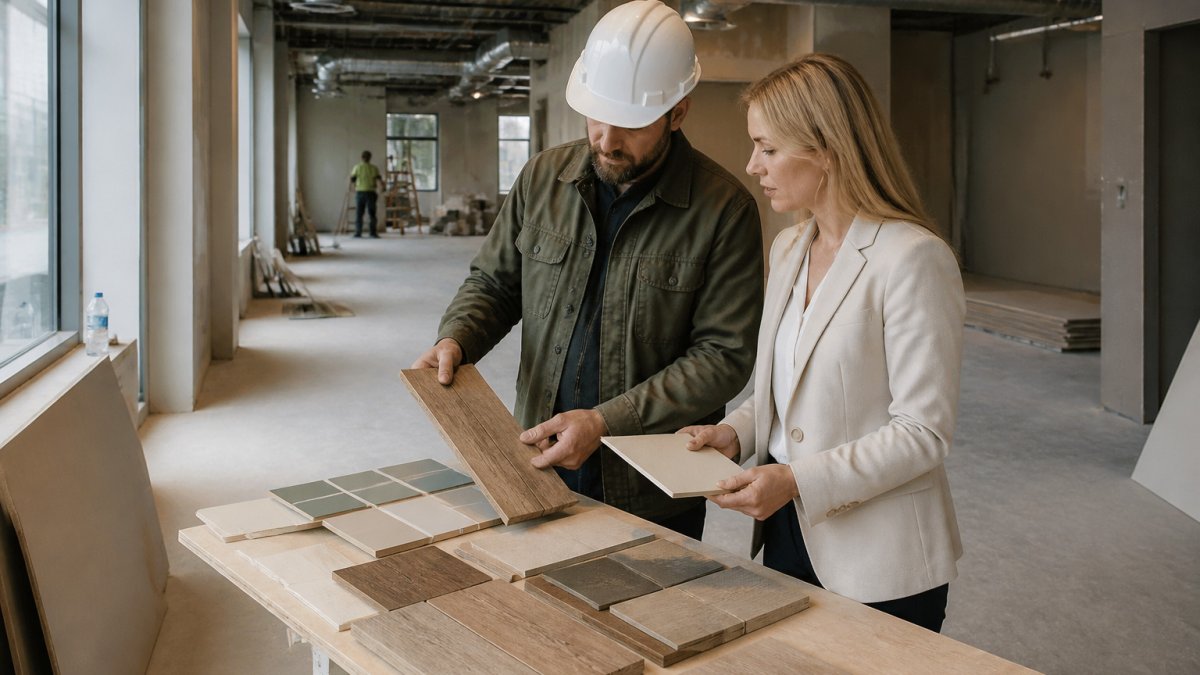
Start by matching the material to the type of upgrade, not the other way around. A lobby refresh, a tenant build-out and a full envelope retrofit each call for different materials and different tradeoffs. The table below is a starting point, but the notes that follow explain the practical constraints that decide whether a material actually works in an occupied commercial building.
| Upgrade Type | Common Sustainable Options | Main Consideration |
|---|---|---|
| Interior refresh | Low-VOC paints, reclaimed wood | Indoor air quality, finish durability |
| Tenant build-out | Recycled-content partitions, salvaged fixtures | Speed, reuse, load limits |
| Envelope retrofit | Insulation, recycled-content siding | Thermal performance, moisture control |
| Structural addition | Recycled steel, low-carbon concrete | Code compliance, engineering approval |
Every upgrade has a budget ceiling and a schedule. Before you commit, ask your design team whether each material can be installed without triggering a larger scope of work, for example, whether new cladding requires structural upgrades or whether a ceiling replacement forces sprinkler and HVAC modifications. That single question prevents more budget surprises than any product comparison.
Green Building Materials for Commercial Buildings: Structure and Envelope
Structure and envelope materials have the largest effect on a building's lifetime carbon and energy use. They are also the hardest to change later, which is why they deserve early attention.
Recycled Steel and Reclaimed Wood
Reclaimed wood brings warmth and a story to a space, but it is not a plug-in substitute for new lumber. Inspect each piece for structural soundness, moisture content and treatments. Plan for extra time in sorting and milling.
Low-Carbon Concrete and Mass Timber
Low-carbon concrete uses supplementary cementitious materials or alternative mixes to reduce the carbon emissions of a standard pour. Ask your supplier for mix-specific environmental data rather than relying on general claims.
Recycled Building Materials for Interiors and Finishes
Interior finishes are where occupants feel the most immediate effect. They also tend to be replaced more often, so durability and maintenance matter as much as recycled content.
- Compare recycled content percentages with verified test results
- Check that finishes meet your maintenance crew's cleaning routine
- Confirm that salvaged items meet current accessibility and code rules
Low-Carbon Construction Materials and Lifecycle Data
Lifecycle data helps you compare materials on a like-for-like basis. An environmental product declaration, or EPD, reports the environmental impact of a product using a standard method. Many manufacturers now publish them, and many project teams request them during procurement.
When reviewing lifecycle data, focus on three things: the functional unit being compared, the system boundary used, and the period the data covers. Two products with similar embodied carbon figures may not be comparable if they were measured differently.
Lifecycle assessment is more than a single number. It captures production, transport, installation, maintenance and end-of-life disposal. For commercial owners, the operating phase is often the largest part of the picture, which is why energy performance matters so much.
Cost, Payback, and Total Cost of Ownership
Sustainable materials are not always more expensive upfront, but they can carry different costs at each stage of the project. Pricing depends on quantity, delivery dates, local supply and whether specialty installers are needed. Ask for current quotes rather than relying on published price lists, and separate material cost from installation cost so you can compare options fairly.
Total cost of ownership is the better way to compare options. It adds the initial purchase, installation, maintenance, energy use and eventual replacement. A material with a higher purchase price may cost less over the building's life if it lowers energy bills or lasts much longer. The hard part is estimating each line without overstating savings. Accounting for the end-of-life value of components requires a careful assessment of the benefits of building deconstruction to ensure that salvageable assets are properly credited against the total project expenditure.
Use this checklist to build a side-by-side comparison:
- Initial material and installation cost, quoted separately
- Expected maintenance interval and cost, based on the manufacturer's published guidance
- Projected energy savings, based on engineering analysis rather than product claims
- Expected replacement cycle and disposal cost
- Any incentives or financing your project qualifies for
Payback logic. Payback is simply the upfront premium divided by the annual savings. If a higher-performance insulation package costs more upfront but reduces energy use, the payback period is the extra cost divided by the annual energy savings. Finishes rarely pay back on energy alone; their case rests on durability, maintenance and occupant outcomes.
Maintenance and durability. A low-impact product that needs replacing in five years may have a bigger footprint, and a bigger lifetime cost, than a more durable option that lasts thirty. Ask suppliers for expected service life and maintenance requirements, and check whether your maintenance crew can service the product with existing tools and routines.
Procurement and incentives. Incentive programs change often, so confirm current eligibility with the relevant agency or your utility before you include them in a budget. Ask suppliers for documentation, EPDs, test reports, recycled-content declarations, rather than accepting a logo on a brochure.
To estimate payback for your building, start with the upgrade type, the performance goal and the constraints you identified earlier. That sequence keeps the cost conversation grounded in what the building can actually support.
Retrofit Constraints, Certifications, and Next Steps for Your Upgrade
Every commercial retrofit runs into constraints. Existing structures limit load, ceiling heights limit duct routing, and occupied buildings limit working hours. Build these limits into material selection from the start.
Ask suppliers for documentation rather than accepting a logo on a brochure.
Here is a practical next-step sequence for your upgrade:
- Define the upgrade type and the performance goals.
- Inspect the existing structure, systems and access limits.
- Shortlist materials that fit the constraints and the budget.
- Request EPDs, test reports and certifications for each option.
- Compare total cost of ownership, not just the purchase price.
- Confirm installation requirements with your contractor before ordering.
If you are planning a commercial upgrade and want help matching materials to your building, you can request an estimate from our team. Our team can review the constraints, compare options and explain the cost tradeoffs in plain terms. You can also learn more about our commercial remodeling services to see how we handle projects of different sizes.
For a broader look at managing renovation costs, read our guide on avoiding surprise renovation costs.
Frequently Asked Questions
What are the most sustainable materials for commercial buildings?
The most widely used options include recycled steel, reclaimed wood, mass timber, low-carbon concrete and low-VOC paints and finishes. Each addresses a different part of the environmental footprint: recycled steel and mass timber reduce embodied carbon in the structure, reclaimed wood reduces demand for new harvesting, and low-VOC finishes improve indoor air quality for occupants. The right choice depends on the upgrade scope, the building's existing structure and the performance data available from the supplier.
Are recycled building materials suitable for commercial building upgrades?
Yes, recycled materials such as recycled steel and recycled-content insulation are commonly used in commercial projects. Confirm recycled content percentages with manufacturer documentation, check that the product meets the structural or fire-rating requirements for your application, and verify that local availability supports your project schedule before specifying them.
How do you choose sustainable materials for a commercial renovation?
Start by matching materials to the upgrade type, such as envelope, interior finishes or structural work, rather than selecting products in isolation. Then compare verified environmental product declarations, lifecycle carbon data, durability and maintenance needs, and total cost of ownership over the expected service life. Confirm that each product meets the code and procurement requirements that apply to your project.
Sustainable materials can make a commercial upgrade healthier, more efficient and more durable when they fit the building and the budget. Start with the upgrade type, verify every claim with data, and compare options over the full life of the building.