 How-to
Luxury Custom Finishes for Suffolk Home Remodels
Last Updated: November 2, 2026
Quick Summary
Luxury custom finishes are chosen by following a set sequence: set a palette, rank rooms by daily use, view full-size samples, build a finish schedule, and lock long-lead items first. Kitchens and primary baths usually get the largest share of the finish budget.
- Pick two or three core materials plus one accent before shopping for any finishes.
- Request full-size samples and view them in natural light at midday and evening.
- Lock long-lead items like stone slabs and custom cabinetry before approving short-lead finishes.
- Define each finish at standard, upgraded and premium tiers before placing any orders.
- Specify corrosion-resistant fixtures for exposed locations because of Suffolk County's coastal humidity and salt air.
Table of Contents
- What Counts as a High-End Home Finish
- A Practical Process for Selecting Luxury Finishes
- Custom Kitchen Finishes: Materials, Durability and Upkeep
- Luxury Bathroom Finishes and Moisture Considerations
- Luxury Home Remodeling in Suffolk County: Climate and Home Factors
- Transparent Finish-Level Budgeting and Specification Documents
- Requesting a Finish Plan and Free Estimate from Allied Construction Corp
- Frequently Asked Questions
Luxury custom finishes are what separate a Suffolk remodel that feels like a retreat from one that just looks updated. Homeowners often spend months on layout and then rush the finish decisions, where most of the daily experience actually lives. Countertops, cabinetry, tile, hardware and fixtures are the surfaces you touch every day, and they are the hardest to change later.
The good news is that finish decisions follow a logical process. The guide below walks through what counts as a high-end finish, how to choose among them, and how to plan for budget, specifications and timing before you request an estimate.
What Counts as a High-End Home Finish
A high-end home finish is a material or fixture chosen for durability, craftsmanship and visual quality rather than for the lowest price.
In practice, the categories that move a remodel from standard to luxury include:
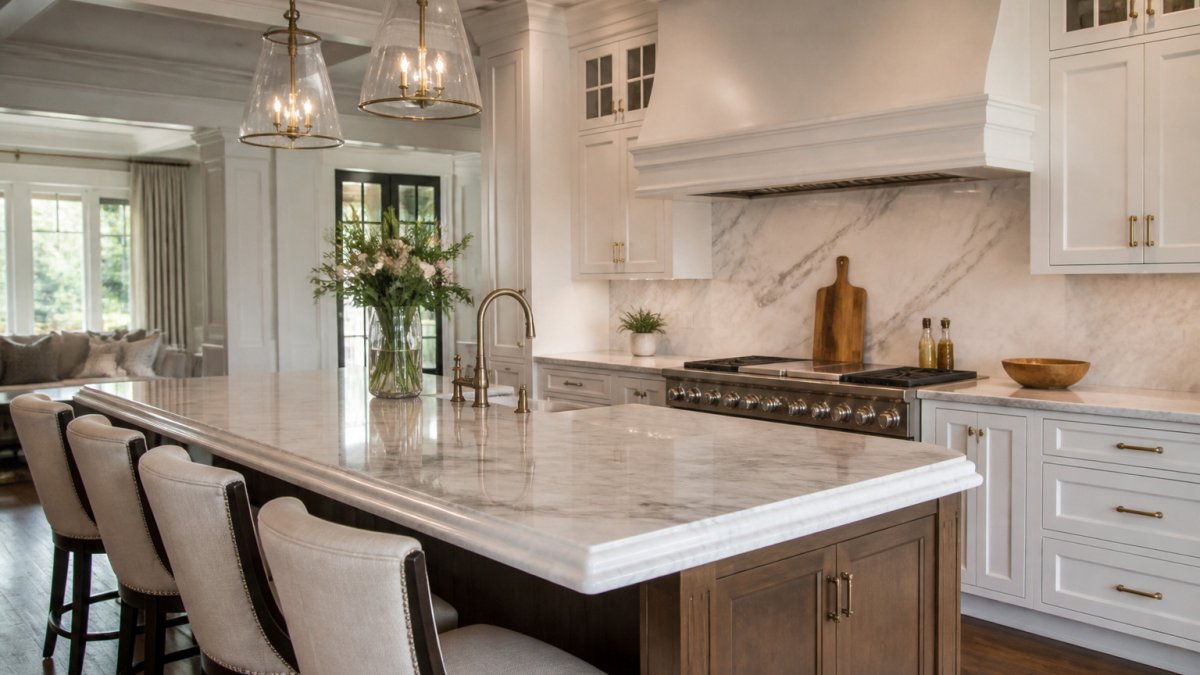
- Natural stone countertops such as quartzite, marble or honed granite
- Custom cabinetry with solid wood or high-grade veneer construction
- Large-format tile and seamless floor transitions
- Solid-core doors, architectural trim and plaster or specialty wall finishes
- Plumbing and lighting fixtures with consistent finish families
Not every surface needs the top tier. A common approach is to spend most of the budget on the surfaces used most often, such as the kitchen work zone and primary bath, and select mid-grade materials elsewhere.
A Practical Process for Selecting Luxury Finishes
The process below is built around a single principle: every finish decision should be made once, in the right sequence, and recorded before the next trade is scheduled.
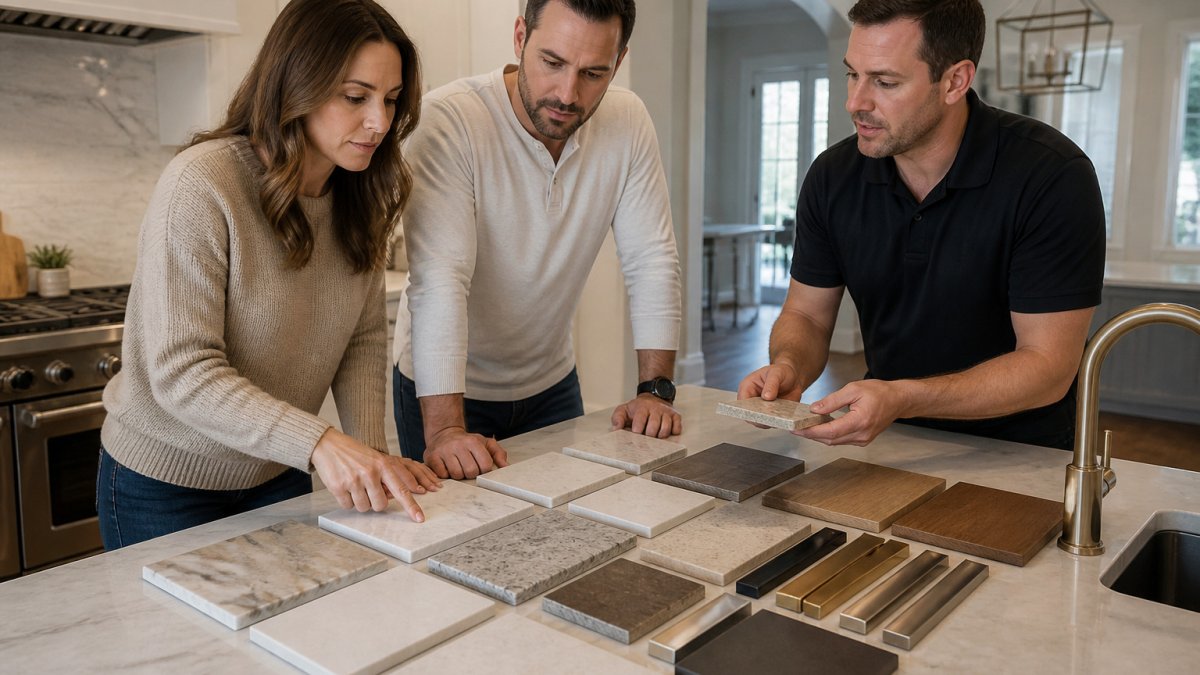
Stage 1, Establish the palette before shopping. Pick two or three core materials (for example, a stone, a wood tone, and a metal finish) and one accent. The palette is a constraint, not a wish list. Homeowners who skip this stage tend to fall in love with individual products that cannot coexist. Bring the palette to every showroom visit so samples are judged against it, not in isolation.
Stage 2, Rank rooms by daily use and resale impact. Kitchens and primary baths usually earn the largest share of the finish budget because they are used daily and appraised closely at resale. Secondary baths, laundry rooms, and mudrooms can absorb mid-grade finishes without hurting the overall impression. Write the ranking down; it becomes the tiebreaker when two rooms compete for the same slab or tile run.
Stage 3, Request physical samples, not photos. Screens and printed catalogs shift color and sheen. Ask for full-size samples and view them in the home's natural light at both midday and evening. Stone and wood vary slab to slab, so request the actual piece that will be installed, or at least a photo of the specific bundle, before approving.
Stage 4, Build the finish schedule. A finish schedule is a room-by-room table listing every surface and fixture with manufacturer, product name, color or finish code, supplier, quantity, and approval date. Ask your contractor for a draft schedule before work begins and review it line by line.
Stage 5, Lock long-lead items first. Stone slabs, custom cabinetry, and specialty tile can take weeks to arrive. Sequence decisions so long-lead items are approved before short-lead ones, and treat any post-approval change as a schedule risk, not just a cost risk.
Stage 6, Confirm installation notes. The finish schedule should carry installation notes: grout color and type, sealant products, trim profiles, and transition details. These notes are where most mismatches are prevented, because they tell the installer exactly what the designer intended.
Watch out: approving a finish from a photo alone is a common source of disappointment, and approving a substitute mid-project without updating the schedule is the most common source of change orders.
The six stages below can be scanned quickly, showing what to do at each point and when the decision should be locked.
| Stage | What to do | Timing |
|---|---|---|
| 1. Establish the palette | Pick two or three core materials plus one accent | Before shopping |
| 2. Rank rooms | Rank rooms by daily use and resale impact | Before budget is split |
| 3. Request samples | Request full-size samples and view them in natural light | Before approval |
| 4. Build finish schedule | List manufacturer, product, finish code, quantity and approval date | Before work begins |
| 5. Lock long-lead items | Approve stone, custom cabinetry and specialty tile first | Weeks ahead of short-lead items |
| 6. Confirm installation notes | Record grout, sealant, trim and transition details | In the finish schedule |
Custom Kitchen Finishes: Materials, Durability and Upkeep
Kitchens take the most wear, so finish choices here should be judged on how they hold up, not only how they look at install. Natural stone counters need sealing and can etch from acidic foods, while quartz resists staining but has a more uniform look.
Plan upkeep before the kitchen is finished. Ask which sealers the stone requires and how often they should be reapplied, and confirm the cabinet finish can be touched up without refinishing an entire run.
Luxury Bathroom Finishes and Moisture Considerations
Bathrooms add a constraint kitchens do not: constant humidity and water exposure. Finish selection should account for moisture first and appearance second. Porcelain and large-format tile with low water absorption handle wet areas well, and grout choice matters as much as tile choice.
For vanities, solid surface and quartz tops tolerate splashes better than unsealed natural stone. Metal fixtures should carry a finish rated for regular bathroom use, and any natural wood cabinetry needs moisture-resistant construction and sealing around the sink cutout.
Luxury Home Remodeling in Suffolk County: Climate and Home Factors
Suffolk County homes face specific conditions that affect finish performance. Coastal humidity and salt air can accelerate corrosion on exterior hardware and some metals, so specify marine-grade or corrosion-resistant fixtures for exposed locations. Older housing stock may have uneven walls and subfloors, which affects how stone and large tile are installed and how much preparation is required.
Seasonal temperature swings also matter for wood and stone. Solid wood expands and contracts with humidity, so cabinetry and flooring should be acclimated before installation. Homes in flood-prone or storm-exposed areas should also review finish durability with the contractor, since water-resistant materials are easier to restore after an event.
Transparent Finish-Level Budgeting and Specification Documents
Budget surprises in luxury remodels usually come from undefined finish levels, not from the price of any single item. The fix is to define each finish at three tiers, standard, upgraded, and premium, and compare how each tier changes the total before a single order is placed.
What actually drives finish cost. Five factors move the number more than any other: material quantity (square footage of stone, tile, and flooring), material availability (a slab that must be sourced from a distant quarry carries freight and lead-time cost), site conditions (uneven substrates require more prep and more adhesive), schedule (rush orders and overtime installs cost more), and installation complexity (a herringbone tile pattern takes longer to set than a stacked layout). Any price quoted without those details is a placeholder, not a budget.
How the tiers differ in practice.
Build a finish-level comparison. For each room, list the finish options you are considering and compare them with your contractor before deciding where a higher finish level is worth the cost.
Document your choices. Keep a written record of finishes by room, including manufacturer, product name, color or finish code, and approval date, so any proposed substitute can be reviewed against your approved selections.
Ask your contractor to walk through your finish choices before work begins.
Requesting a Finish Plan and Free Estimate from Allied Construction Corp
If you are planning a luxury remodel in Suffolk County, the most useful next step is a finish plan built around your home, your budget and your timeline. Allied Construction Corp works with homeowners across Nassau and Suffolk counties on kitchen and bathroom projects. A finish plan that aligns materials, budget and timing can keep each decision connected to the larger goal, so it helps to plan a luxury renovation step by step.
To begin, request a free estimate or reach out through our contact page. For projects that involve kitchen or bath work, you can also review our kitchen remodeling and bathroom remodeling services. Pricing depends on scope and materials, so contact Allied Construction Corp for a current quote.
Frequently Asked Questions
What are considered high-end finishes in a home?
High-end finishes are materials and fixtures chosen for quality of material, workmanship and longevity rather than trend. Common examples include natural stone countertops such as quartzite or honed marble, solid hardwood flooring, custom cabinetry with soft-close hardware, and plumbing fixtures from established brands with durable finishes. What distinguishes them is consistency: the materials are coordinated across rooms and installed with precision. Allied Construction Corp can walk you through material options for your specific project. Current pricing depends on material selection, quantities and schedule, so request a quote from Allied Construction Corp for accurate figures.
How do I choose finishes that work together throughout my home?
Start with a small set of anchor materials, such as flooring and cabinet species, then limit the palette so that metals, stone tones and paint colors repeat across rooms. Compare samples in the actual light of the rooms they will occupy, since a stone that looks warm in a showroom can read cool in a north-facing Suffolk room. Document the final choices in a specification sheet listing manufacturer, model, finish and location, so that every trade orders the same product. This prevents mismatches between a kitchen and an adjoining dining room.
Are luxury finishes worth the cost in a home renovation?
They are most worth it in surfaces you touch and see daily, such as countertops, cabinet hardware, flooring in main living areas and bathroom fixtures, and least worth it in concealed or rarely used areas. Durability is the deciding factor: a higher-grade sealed stone or solid wood floor that lasts decades usually costs less per year of use than a cheaper material that must be replaced. Allied Construction Corp can help you decide which upgrades justify their cost for your home and budget. Request a free estimate to see figures for your project.
How can I compare finish samples before choosing materials?
Request full-size samples rather than small chips, and view them at the times of day you will use the room. Place samples together on the actual cabinet or wall area, and check them under your own lighting, including any natural light from windows. Test sealed stone and wood samples with water and a common household cleaner to see how they respond. Keep a written record of the sample name, manufacturer and finish code so your choice can be ordered accurately later.