 Listicle
Best Bathroom Lighting on a Budget for 2026
Last Updated: November 5, 2026
Quick Summary
The best budget bathroom lighting puts function first: simple vanity bars and sconces in matte black or brushed nickel, dimmable warm-white LEDs around 2700K to 3000K, and moisture-rated fixtures. Keep existing wiring locations to cut installation labor, and spread your budget across ceiling and vanity layers instead of one showpiece.
- Simple shapes and finishes read as expensive; busy scrollwork and shiny brass look dated.
- Warm white LEDs around 2700K to 3000K flatter skin tones better than cool white at 4000K and up.
- Two sconces at eye level flanking the mirror eliminate shadows better than one overhead bar.
- Swapping a fixture into an existing junction box is the one job most confident DIYers can handle.
- Skipping a moisture-rated fixture usually means replacing it within a couple of years.
Table of Contents
- Why Bathroom Lighting Matters More Than You Think
- Affordable Bathroom Light Fixtures That Still Look Expensive
- LED Bathroom Lighting: The Budget-Friendly Workhorse
- Bathroom Vanity Lighting Ideas That Fix Bad Shadows
- Small Bathroom Lighting Ideas for Tight Spaces
- How to Save on Installation Without Cutting Corners
- Mistakes That Make Budget Bathroom Lighting Look Cheap
- Planning Your Bathroom Lighting Upgrade with Allied Construction Corp
- Frequently Asked Questions
Why Bathroom Lighting Matters More Than You Think
Good bathroom lighting is the difference between a room that feels finished and one that feels like a rental.
Here's what most budget guides get wrong. They treat lighting as a style decision when it's really a function decision. Get the function right first, and the room looks better almost by accident.
The U.S. Department of Energy's lighting guidance makes a simple point worth repeating: light quality, color temperature, and placement matter more than fixture price. A cheap fixture in the right spot beats an expensive one in the wrong spot every time.
Affordable Bathroom Light Fixtures That Still Look Expensive
The cheapest-looking bathroom fixtures share one trait: they try too hard. Busy scrollwork, shiny brass finishes, and oversized glass shades all read as dated. Simple shapes read as expensive.
A useful way to shop is to sort fixtures into three budget tiers. Most homeowners find the middle tier is where the value sits: you pay a little more than builder grade but far less than designer showroom pricing, and the finish and diffuser quality hold up in a humid room.
Vanity Bars and Wall Sconces
A three-light vanity bar in a matte black or brushed nickel finish covers most standard vanities and typically lands in the entry tier. Look for fixtures with exposed bulbs and simple backplates; the fewer parts, the less there is to look dated or collect hard-water film.
Pros: simple shapes photograph well, easy to swap later, widely available at home centers and online. Cons: builder-grade finishes can pit over time in humid rooms, so check the finish warranty and favor powder-coated or lacquered finishes over thin plated ones.
Recessed and Flush-Mount Options
Recessed cans are the workhorse of budget bathroom lighting. A flush-mount ceiling fixture in frosted glass spreads light evenly and costs less than a chandelier-style piece. For low ceilings, flush-mount is the only option that doesn't crowd the room. If you are replacing existing cans rather than cutting new holes, the fixture cost is modest; the labor is what moves the number.
Pros: clean look, low profile, inexpensive to replace. Cons: recessed cans need ceiling access, which raises installation labor if you're cutting new holes, and cheap cans with plastic trim yellow over time.
Where the Money Actually Goes
Three cost drivers separate a fixture that looks expensive from one that looks cheap, and none of them is the price tag alone:
- Diffuser quality. Frosted glass or acrylic spreads light evenly; bare bulbs and thin shades create hot spots that read as builder grade.
- Finish consistency. A single finish across every fixture in the room matters more than which finish you pick. Mixed metals can work, but mixed quality of finish never does.
- Backplate size. A backplate that covers the existing junction box opening looks intentional; one that leaves a gap looks like a mistake.
A common pattern is that homeowners overspend on the vanity fixture and underspend on the ceiling light, which can leave a room feeling flat. Spreading the budget across layers instead of putting it all in one showpiece is one way to avoid this.
Watch out: buying a fixture before measuring the junction box is the most common return reason, confirm the backplate covers the opening and the wire count fits before you order.
LED Bathroom Lighting: The Budget-Friendly Workhorse
LED bathroom lighting wins on running cost, not just sticker price. LEDs use far less energy than incandescent bulbs and last years longer, which is why the U.S. Department of Energy's LED explainer recommends them for high-use rooms.
Watch the color temperature. Warm white (around 2700K to 3000K) flatters skin tones in a bathroom. Cool white (4000K and up) makes the room feel clinical and harsh.
Note that some integrated LED fixtures are sealed units, so a failed driver can mean replacing the whole fixture rather than the bulb.
Here are the key LED facts to keep in mind when shopping on a budget.
| Item | Value | Note |
|---|---|---|
| Warm white color temperature | Around 2700K to 3000K | Flatters skin tones in a bathroom |
| Cool white color temperature | 4000K and up | Makes the room feel clinical and harsh |
| Bulb choice | Dimmable LEDs | Pair with a compatible dimmer switch |
| Non-dimmable bulbs | Flicker when dimmed | Cheap non-dimmable bulbs flicker |
| Integrated LED fixtures | Sealed units | Failed driver can mean replacing whole fixture |
| Running cost | Far less energy than incandescent | Last years longer |
Bathroom Vanity Lighting Ideas That Fix Bad Shadows
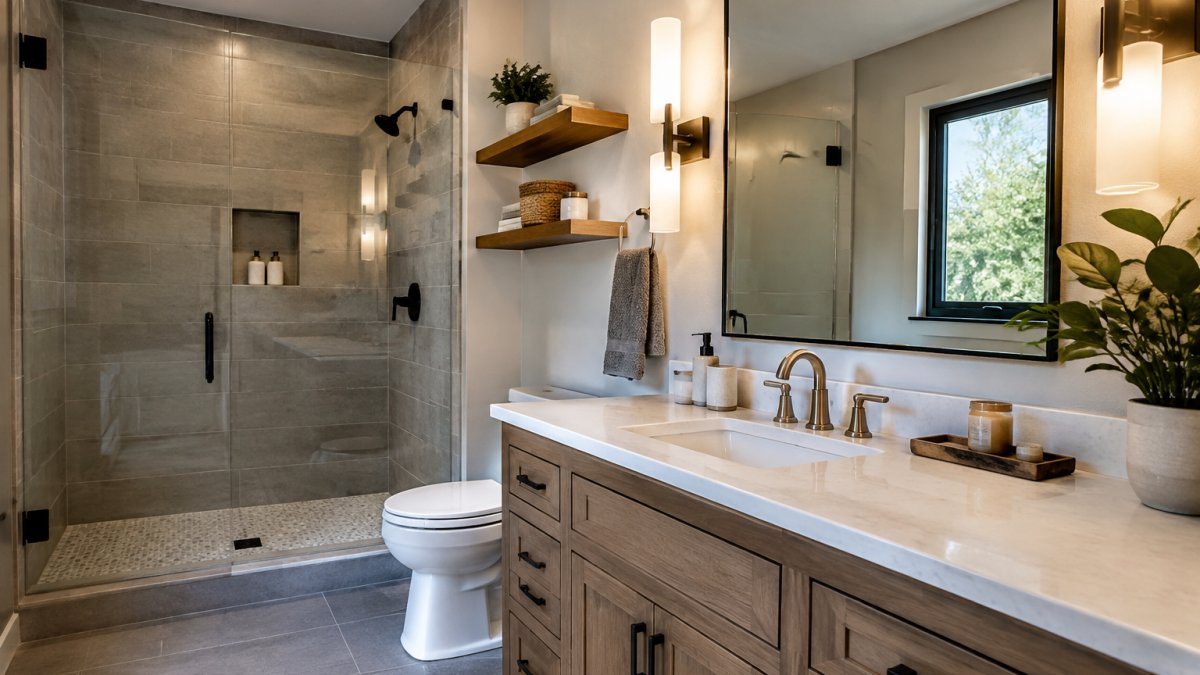
The fix for bad shadows is side lighting, not more overhead light. Two sconces flanking the mirror at face height light the front of your face evenly.

For a budget-friendly version, mount two simple sconces at eye level and skip the overhead bar entirely. If wiring two new sconce locations isn't in the budget, a single wide bar with frosted diffusers placed closer to the mirror reduces shadows more than a small fixture hung high.
Three placement rules that matter:
- Put sconces at eye level, roughly mirror-center height
- Keep light in front of the face, not behind it
- Layer overhead light with vanity light so the room never depends on one source
Small Bathroom Lighting Ideas for Tight Spaces
Small rooms need light bounced off surfaces, not pointed at people. A flush-mount ceiling fixture plus a mirror-adjacent sconce covers a half bath without crowding it. Skip pendants in low-ceiling rooms; they eat headroom and cast shadows.
For a tight space, aim for three light layers: ambient from the ceiling, task at the vanity, and a soft night light near the floor. Recessed cans spaced evenly prevent the "one bright spot, dark corners" look that makes small bathrooms feel smaller.
If your space is genuinely cramped, the layout often matters as much as the fixtures. Our team handles bathroom remodeling and can help you think through the layout of a smaller space.
How to Save on Installation Without Cutting Corners
Installation is often the number that decides a lighting project's total cost, so it is worth understanding where labor costs come from and how to keep them down without creating a safety or code problem.
The biggest installation savings come from keeping existing wiring locations. Swapping a fixture into an existing junction box is a straightforward job that many homeowners can do themselves. Adding new circuits, cutting ceiling holes, or moving a vanity light requires an electrician and adds real cost, because the labor is in the wall and ceiling work, not the fixture.
What Drives the Labor Cost
- New wiring runs. Every new switch leg or circuit means fishing cable through finished walls, which is slow, skilled work.
- Ceiling access. Cutting new recessed holes in a finished ceiling means patching and repainting afterward, and that finish work often costs as much as the electrical work.
- Fixture weight and mounting. A heavy fixture needs blocking or a fan-rated box; a lightweight flush-mount does not.
- Permits and inspection. Most jurisdictions require a permit for new circuits, and the inspection adds a step to the schedule.
DIY Versus Hiring a Pro
The decision comes down to three questions. Are you comfortable working with the power off and testing for live wires? Does the job involve new circuits or only a fixture swap? And does your local code require a permit for the work?
Where you should not cut corners: moisture-rated fixtures. Bathrooms are wet locations, and standard fixtures corrode.
A common mistake is buying a fixture before checking the junction box. Measure the box size, note the wire count, and confirm the fixture's backplate covers the opening. Returns cost time and sometimes restocking fees.
Watch out: skipping a moisture-rated fixture to save a few dollars usually means replacing it within a couple of years, which costs more than buying the right one once.
If you're weighing DIY against a pro, our FAQs answer the questions homeowners ask most before deciding. And if you want to avoid the surprise costs that derail renovation budgets, read our guide on how to avoid surprise renovation costs in 2026 before you buy anything.
Mistakes That Make Budget Bathroom Lighting Look Cheap
Mismatched color temperatures can make a room look unfinished. Warm bulbs next to cool bulbs are a common cause, so buying bulbs in one color temperature is a practical habit.
Other common mistakes:
- Too few light sources. One overhead fixture flattens a room.
- Glossy finishes in a humid room. Matte finishes hide water spots; polished chrome shows every one.
- Overbright bulbs. More lumens is not better. A bathroom needs even light, not blinding light.
- Ignoring the dimmer. A dimmer costs little and changes how the room feels at night.
Watch out: skipping a moisture-rated fixture to save a few dollars usually means replacing it within a couple of years, which costs more than buying the right one once.
Planning Your Bathroom Lighting Upgrade with Allied Construction Corp
A lighting upgrade is one of the least disruptive bathroom projects you can take on, and it's often the one homeowners put off longest. If you'd rather hand the whole thing to a licensed contractor, we handle bathroom remodeling across Nassau and Suffolk counties and all five boroughs.
We're a licensed home improvement contractor. If you want a clear number before committing, you can request a free estimate.
Get started with Allied Construction Corp and upgrade your bathroom lighting without the guesswork.
Frequently Asked Questions
What is the best lighting for a bathroom on a budget?
Start with a layered setup: one central ceiling fixture for general light, a vanity bar or two sconces for task lighting, and a small nightlight for overnight use. LED fixtures cost less to run and last years longer than incandescent bulbs. You do not need to replace every fixture at once. Upgrading the vanity light first usually gives the biggest visible improvement for the lowest cost.
How many lumens do I need for bathroom lighting?
A general rule is about 75 to 100 lumens per square foot for a bathroom. A typical 50-square-foot bathroom needs roughly 4,000 to 5,000 total lumens across all fixtures. Split that between a ceiling light and vanity lighting so you are not relying on one source. For vanity task lighting, aim for 1,500 to 2,000 lumens directly over or beside the mirror.
Are LED lights a good choice for bathroom lighting?
Yes. LED bathroom lighting uses far less electricity than incandescent or halogen bulbs and lasts much longer, so the higher upfront cost pays back quickly. Look for fixtures rated for damp locations, which is required in bathrooms because of steam and moisture. A color temperature around 3000K to 4000K gives a clean, natural look without feeling harsh or clinical.
Can I update bathroom lighting without replacing the wiring?
Often yes. If your existing fixture boxes are in good shape and properly grounded, a licensed electrician can swap fixtures without running new wire. Changing a single vanity light is usually a short job. Adding recessed lights or moving a fixture to a new location does require new wiring. Always have a licensed contractor confirm the circuit can handle the load before you buy fixtures.
Budget bathroom lighting comes down to three decisions: simple fixtures, consistent LED color temperature, and side lighting at the vanity. Get those right and the room looks intentional at almost any price point. If you'd rather have a professional handle the wiring and layout, our team is ready to scope your project and give you a straight answer on what it takes.